
Sin Eaters
Taking away the sins of the dead

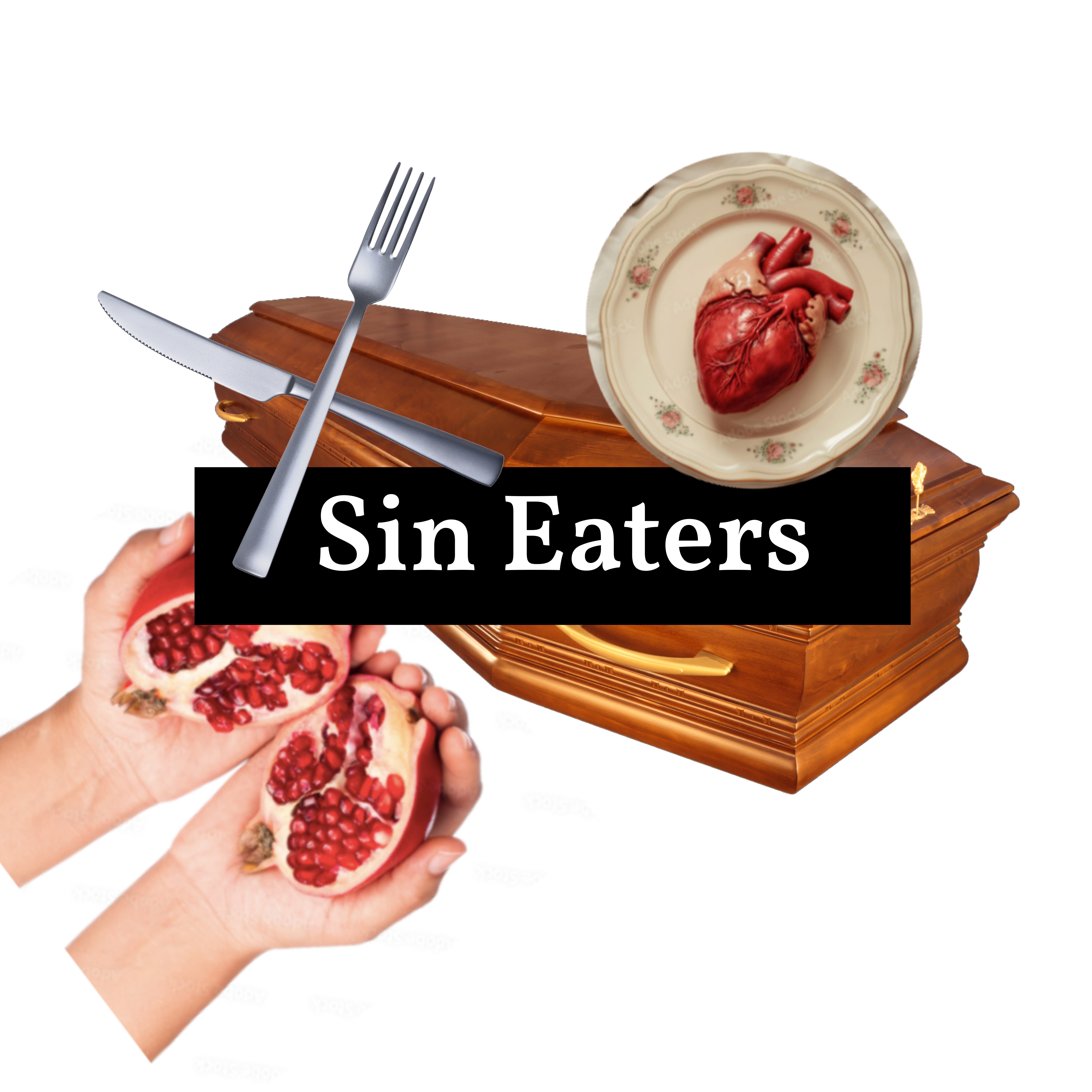
There’s something both haunting and compelling about the tradition of the sin-eater. The very idea that someone within a community could take on the sins of the deceased by eating food placed upon their coffin. Through this ritual, the dead were believed to be freed from their worldly sins, able to pass into heaven unburdened and so avoid the fiery pits of hell.
Though I had heard of the tradition before, Megan Campisi brings it vividly to life in her compelling story, ‘The Sin Eater’. which follows the journey of May Owens, a 14-year-old orphan in 16th-century England who on stealing a loaf of bread, is forced to take on the role of a sin-eater.
Her role is marked by a heavy brass collar that is put around her neck, engraved with an ‘s’, marking her out as someone to be avoided, and even to be spoken to. May is apprenticed to an older sin-eat
Her role, one of the lowest in society, is marked by being forced to wear a heavy brass collar, put around her neck, engraved with an ‘s’, marking her out as someone to be avoided, and even to be spoken to. May is apprenticed to an older sin-eater and the normal range of sins are associated with particular foods:
Dried raisins - adultery,
Orange marmalade for bigamy,
Eel pie for fault-finding,
Roast pigeon for thieving,
Mustard seed for lying,
Cream for envy,
Pomegranate for witchcraft.
May accompanies the older sin-eater to the royal court, where the normal range of foods are laid out in accordance to the sins the person committed in life. Yet an extra item, a deer heart, is laid out but isn’t listed with the dead’s sins. The older woman refuses to eat it, and so is thrown into prison and tortured to death.
While many of the described foods sound quite delicious, the role of the sin-eater is to eat in order to devour another’s sins, often consuming things one would rather not eat. But perhaps the greatest burden is eating quantity of foods, long after hunger has gone.
Scottish Corpse Saining
In his article Scottish Lowland Folk Magic Corpse Saining Rite Scott Richardson-Read (Cailleach’s Herbarium) lays out a folk ritual similar to sin eating by which a poor man from the community who would eat the salt and the bread laid out on a corpse. He was often disfigured or disabled in some way and became a scape goat of sorts for a community’s sin. He would eat the sins of the dead so they could find rest.
Records exist of corpse saining and Scottish folk magic blessing in the manuscripts. This example comes from lowland Scotland so may not pertain to the rest of Scotland. I offer this folk rite to preserve it but also to encourage you with its simplicity. It demonstrates how communities managed their own deaths with no ecclesiastic present.
Once the corpse has been washed and laid out in its shroud, one of the oldest women must light a candle and wave it three times around the corpse. He would eat the sins of the dead so they could find rest.
Then she must measure three handfuls of common salt into an earthen ware plate and lay it on the breast of the corpse. Lastly, she arranges three ‘toom’ or empty dishes on the hearth, as near as possible to the fire. All the attendants going out of the room return to it backwards repeating the ‘Rhyme of Saining’:
Thrice the torchie, thrice the saltie [torchie = candle, saltie = salt]
Thrice the dishes toom for loftie [loftie is praise I think so this would be – three times the dishes empty for praise)
These three times three ye must wave round
The corpse until it sleep sound
Sleep sound and wake nane
Till heavens the souls gane
If ye want that soul to dee [dee would be die]
Fetch the torch frae th’ Elleree
Gin want that soul to live
Between the dishes place a sieve
An it shall have a fair fair shrive. (Shrive is penance, so an easy penance)
This rite is called a ‘Dishaloof’. Sometimes (as is named in the verses), a sieve is placed between the dishes. She who is fortunate enough to place her hand in it is meant to do the most for the soul. Giving it a “fair shrive”. If all miss the sieve it augurs bad for the soul. [footnote] Sieves make an appearance in a lot of Scottish divinations rituals involving the future and the dead. [/footnote]
In other western counties, the dishes are set upon a bunker close to the deathbed and whilst the attendants sit with their hands in the dishes they ‘spae’. That is, they tell fortunes, sing songs or repeat rhymes. In the middle of which the corpse has been said to rise frowning and place its cold hand in one of the dishes. Presaging death to her whose hand was in that dish. This reflects on the traditions of the dead being animate post death. The connection of the dead to Speaking (fortune telling) is interesting one.
The Dead Cake
The sin eater would attend a brief ceremony prior to the funeral. On the night before the sin eater was due to attend, a funeral a member of the family would bake a cake, known as the dead, or in later years would be come to known as the funeral biscuit. (Hughes).
There are different traditions throughout the UK of death cakes and funeral biscuits, most likely a remnant from the tradition of the sin eater, although not having the same role anymore.
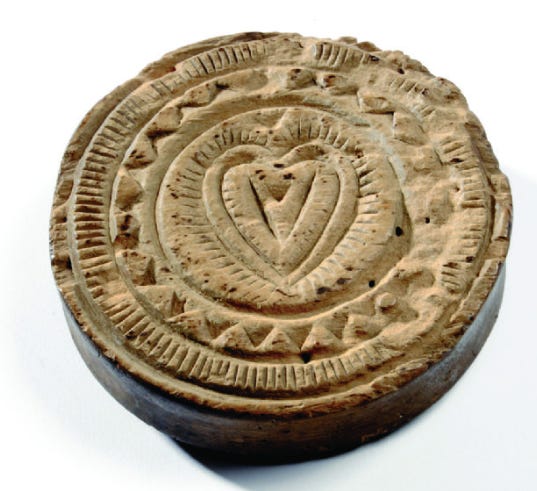
Resource created by Dales Countryside Museum
Funeral Cakes are a Yorkshire Dales tradition, with links back to the Arval bread of the Vikings. They are decorated, shortcake-like biscuits, flavoured with caraway seeds, and wrapped in paper printed with the deceased’s favourite verse or hymn. The cakes are given to visitors to the household, and those attending the funeral.
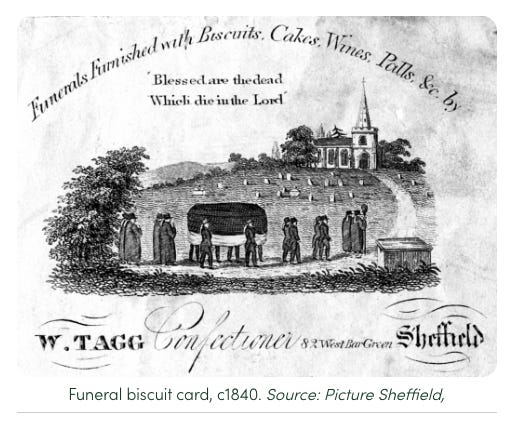
Funeral biscuits were part of the ritual of a Victorian funeral, not made at home but by a specialist local confectioner, as this was considered a sign of status. The biscuits varied in size, shape and consistency but carried a message of mourning, honour and remembrance. There were regional and class variations with two types predominating. The upper classes favoured a savoy biscuit (a sponge finger biscuit) while the lower classes preferred a denser shortbread biscuit, often stamped with a graveyard symbol such as a cross, heart or cherub. Both types were flavoured with aromatic spices to help offset the less pleasant odours at a funeral. The biscuits were wrapped in paper in pairs, sealed with black wax and tied with a black ribbon. The more ornate wax seals may have depicted an hourglass, a skull, or a cherub flying towards heaven.
Sometimes the biscuits were delivered to mourners in advance, acting as a death notice and invitation to the funeral. Some were given out when people went to the house to pay their respects. Other biscuits were presented on the day of the funeral by a young woman, often accompanied by a young man who would offer a sip of spirit from a cup. Other biscuits were handed out at the wake, to be opened and eaten at home, with the printed wrapper as a memento. For those unable to attend the funeral, a pair of biscuits could be delivered by a gentleman clothed in black, with black gloves and a top hat with black drapes, handing out the biscuits from a basket lined with a white cloth.
- https://gencem.org/stories/funeral-biscuits/
The last recorded sin-eater was a man named Richard Munslow, who died in 1906 in Ratlinghope, Shropshire. Unlike many of his predecessors who took on the role of sin-eater out of economic desperation, Munslow came from a relatively wealthy family. He resurrected the practice of sin-eating after three of his children died of whooping cough, and some speculate he did it as a form of grieving. Over time, however, he offered to absorb the sins of the recently departed purely out of kindness and love for his fellow villagers. https://drlindseyfitzharris.com/the-lost-art-of-sin-eating/
Witches, Druids, and Sin Eaters: The Common Magic of the Cunning Folk of the Welsh Marches by Jon G. Hughes. Published 2022
Cake or Death? Sin-eating and other morbid confectionary
Cailleachs Herbarium - Scottish Folk Magic and the Dead (part one) – Funerary customs and death related lore.


So very interesting. I’ve always been fascinated by this. Thank you.
Absolutely fascinating. Thank you